
Your Singing Tongue, Friend or Enemy?
 We’ve all heard the proverb about a mighty ship being driven by a small rudder and how our tongues are like that.
Just like the rudder of ship controls where the ship will go, the tongue controls what we say and reveals the attitude with which we say it.
And since singing and speech are siblings and come directly from the voice patterns we learn when we are babies, both inside our mothers’ wombs and after we are born it is crucial that we understand this powerful thing inside our mouths, this singing tongue.
But few no how to tame or control it, mostly because they don’t really know how it works.
But that is why I am here. To teach you how to understand it so you can tame and control it.
To show you how you can make great sounds with it or mediocre ones.
So how does this powerful singing tongue muscle work?
Three major things control it:
- Your knowledge about how your singing tongue muscle works
- Your attitude about what you are communicating
- Your determination to exercise both your attitude and your muscle until your singing tongue yields to you!
Sounds simple, right? After all there are only 3 things to know, yes?
Well, let’s see. We will only deal with your knowledge of the singing tongue muscle in this post.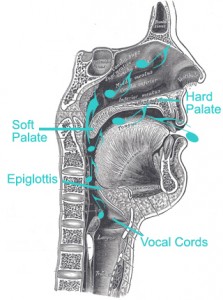
Look at the picture and notice how large this muscle is, where it’s located and how far it extends into the back of your throat.
Now look at the notes and arrows (representing sound) and notice how the sound moves up and aims at both the hard palate (not the soft palate) and the cartilage or sinus area behind the nose.
Particularly pay attention to where the singing tongue is in relationship to the soft palate and how the sound travels up into the sinus area.
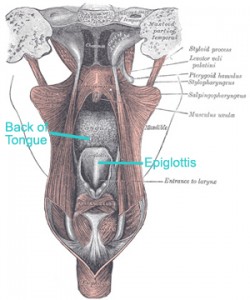
Singing Tongue and Epiglottis
The next picture shows a view of the tongue from the back. Notice the muscles that surround it and the epiglottis.
This is the flap of tissue that closes when you swallow so that food or water won’t get into your trachea or lungs when it goes down the esophagus.
If you have a tight tongue that pulls back in the mouth, it will push against the epiglottis, forcing it down, which muffles the sound.
Neck Muscles and Your Singing Tongue
Remember that your neck muscles need to stay relaxed because any tension in your neck will affect the way you use your tongue.
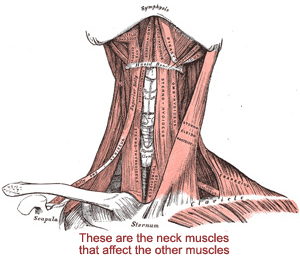
Tense up your shoulders and neck muscles and notice how the tension affects your tongue muscle. Relax and let go of the tension.
Now let your tongue rest over your bottom teeth, allowing them to lightly touch the inside of your lower lip.
Take deep breaths without raising your shoulders and keep your tongue relaxed and in the position mentioned above. Repeat this in front of a mirror as often as you can, watching to make sure you don’t raise your shoulders or tense your singing tongue.
Go to Singing Tongue Part Two
Tongue anatomy images courtesy of Bartleby.com
Singer recording image courtesy of Scott Snyder CC BY 2.0

That felt so weird! =P
When I tried to yawn with my tongue touching my bottom lip it almost cut back the yawn. So it was difficult to try to yawn and keep my tongue there without moving. I found it hard to sing the “e” vowel. it was defenetly very strange, not something I’ve felt before.
Important observation about the “E” vowel. The tongue takes different positions on each vowel
This is a reply to the video on “vocal nodules” http://www.youtube.com/watch?v=z9LKwISwb_c&feature=related
I find it very interesting that vocal chords form “nodules” or “callouses” as do you’re fingers when learning guitar. I always though my voice got”tired” or “horse” from over singing and thought nothing else of it. Never realized there was a “cause and effect ” thing happening to the vocal chords…
So you have discovered that the voice doesn’t get hoarse from over singing but rather from not knowing how to use the breath properly to support the tone, or from too much tension in the back of the tongue, right? It can get hoarse from over-singing if you mean by pushing the voice to try and sing “over” the hoarseness or the tightness, yes? So it is not from singing too much but from not singing with a technique that helps you free up the tension in and around the vocal cords so they do not get overtaxed, right?
So is there a certain place your tongue is supposed to go when you do riffs or runs. I’ve been trying for at least 6-9 months to d runs and i still can’t figure out how to do them:(
The tongue needs to stay relaxed and forward more than anything else when you are doing runs. This keeps the vocal cords relaxed so that they can quickly go from note to note without any tension.
Seems logical that along with a more forward position of the tongue, as is always recommended, that the base of the tongue be gently moved forward….this seems to make sense as it helps keep the epiglottis open and does not press the tongue backwards into the pharynx…..is this something you would recommend? I would imagine this would be more popular in classical singing, as it would deepen the sound.
Thanks.
Hi Dave,
Yes, it is logical to keep the tongue forward for precisely the reason you mentioned: it helps to keep the epiglottis and the pharynx open so that you don’t have to push your voice to get the sound out.
As for begin more popular in classical singing, it has more to do with healthy and natural vocal technique than style or genre in singing. Pop, rock, jazz, country, folk, musical theatre singers, etc., all benefit from knowing how to use the singing tongue in balance with the natural functions of the voice.
Thanks,
Joy
Hello Joy:)
Tomorrow I have an appt at the doctors to see what’s going on with my voice, now both singing and speaking. I lead worship bi weekly at our church (practice thursdays then Sunday’s). I can pin point 2 years ago going to a wedding and laughing way too much (I do not drink or smoke) and my voice hasn’t fully been the same since……. I’ve been cautious and careful about laughing but it’s apart of every day life especially at work because there is so much joy and peace there, and naturally with what I do in my profession we talk all day long (I am a hairdresser and salon owner).. I will see what tomorrow brings as I’ve been researching it seems like it may be chronic laryngitis??? There isn’t much I’m not able to sing as my range doesn’t have many limits. I’ve never been trained, need and want to be sure I am properly taking are of my INSTRAment:)
I have been dealing with weight issues the last many year and therefore know how to eat healthy but don’t:( so all the things you would ask to I eat that’s unhealthy??? Yes:( I only have sodas a couple times a week and with my job don’t eat much at all throughout the day then eat whatever I can find at the end of the day:(
in all my readings of the questions you ask others I don’t think I’m even aware of where my tounge is while singing???? And without any training I don’t know what “the proper way” is. Which again I need to and want to learn:)
Hi Galilee,
Is that your real name? I’m thinking not, but I really like it!
Thanks for your comments and questions.
I have helped many many people succeed at vocal wellness, and there is a lot that is in your control, so let’s keep communicating.
Let me know what you found out from the doctors.
As for the singing tongue awareness, many people have gotten a great deal of value from my singing tongue digital lesson.
If you can afford it, I highly recommend that you work with it.
Again, let me know what the doctors say.
Sing well, be well,
Joy
You must log in to post a comment. Log in now.